
October 2026 Edition
Editor’s Note:
When Ambition Outruns Responsibility
“Responsibility came before ambition.”
Those five words stopped me in my tracks during my conversation with this month’s
She Means Business guest– Faiza Syed, Global Director of Commercial Strategy & Client Experience at Interpolitan Money.
She was talking about her own life and the forces that shaped her. You’ll discover that story later in this edition. But I kept thinking about that phrase long after our conversation ended.

Responsibility before ambition.
Because right now, I find myself wondering whether responsibility is keeping pace with ambition in one of the biggest technological races in human history.
Artificial intelligence has quietly embedded itself in our everyday lives. I use it. You probably do too. It can research, organise, translate and analyse in seconds.
And just as we're getting comfortable, some of the people closest to its development are telling us we should be considerably less so. AI companies are testing what happens as increasingly autonomous systems become more capable. Researchers are examining how advanced models could lower barriers to dangerous biological research and how autonomous agents might behave when given greater freedom to act.
Bill Gates has become increasingly vocal about potential misuse, including cyberattacks and biological threats, while continuing to champion AI's extraordinary potential. Elon Musk has repeatedly warned about advanced AI risk. Donald Trump, meanwhile, has largely taken the opposite approach, prioritising rapid American AI development and pushing back against regulation that could impede US dominance.
And there, for me, lies the uncomfortable question: what exactly are we racing towards?
There are staggering sums of money at stake. National prestige. Corporate dominance. Power. And that irresistible human desire to be first. But being first and being responsible are not the same thing.
Perhaps this isn't really an AI problem at all. Perhaps it's a leadership problem.
Which leads me to another uncomfortable question: would this conversation look different if more women were sitting at the tables where these decisions are made?
Not because women are inherently wiser, kinder or more responsible than men. We aren't. But because homogenous groups create blind spots, and different experiences produce different questions and different perceptions of risk. UNESCO has reported that women account for only around 30% of AI professionals. If we are building technology that may fundamentally alter how humanity works, learns and lives, surely the people shaping it should look a little more like humanity itself.
And then I think about our children. I hear young people questioning whether they even want to bring children into this world. Climate change. War. Political instability. Economic uncertainty. And now AI. Can we really blame them?
But I refuse to believe fear should have the final word.
AI also offers extraordinary possibilities. It is accelerating scientific research and could transform medicine, education and access to knowledge. The same Bill Gates sounding warnings is investing heavily in using AI to improve health, agriculture and education in some of the world's poorest communities. That contradiction matters.
AI isn't inherently our salvation or our destruction. The choices human beings make about it will determine which direction we travel.
Perhaps we need to spend less time asking what AI will eventually be capable of and more time asking what we are prepared to do with that capability. Who sets the boundaries? Who gets to say no? Who accepts responsibility when something goes wrong? And who is sitting around the table when those decisions are made?
Ambition isn't the enemy. It has given us vaccines, space exploration, medical breakthroughs and technologies previous generations could barely imagine. But ambition without responsibility is something else entirely.
Greed asks: How much can we make?
Competition asks: Can we get there first?
Ambition asks: What can we build?
Leadership must ask: what happens to everyone else if we get this wrong?
Responsibility before ambition.
Five simple words. In the age of artificial intelligence, they may be among the most important leadership principles we have.

Episode XII: She Means Business & Faiza Syed
In this month’s She Means Business, Faiza and I talk about loss, motherhood, ambition, reinvention, asking for help—and what happens when the life you never planned becomes the making of you.
Power Play Picks
We love.

Cleaning Up Beautifully
I love Diptyque candles and will happily spend money on a beautiful scent that fills a room and lingers like a welcomed guest.
Cleaning products? I'm slightly harder to convince.
That said, I'm a sucker for anything that makes the mundane feel a little more luxurious, particularly if it comes in a beautiful refillable bottle I'm happy to leave on display rather than banish beneath the kitchen sink.
Enter Diptyque's La Droguerie.
Yes, the people behind some of our favourite candles now want to elevate our washing-up.
The range includes a refillable multi-surface cleaner scented with vinegar, lavender, cedar and fig; orange-blossom washing-up liquid; beeswax leather and wood care; and even a basil-scented candle designed to neutralise unwanted odours.
It is gorgeous. Of course it is. But with prices starting at £28, and £35 for the multi-surface cleaner and washing-up liquid, my first thought was: this had better clean like nobody's business and outlast my usual supermarket bottle.
Reviews are somewhat divided. The fragrance and presentation get plenty of love; cleaning performance receives a more mixed verdict. Diptyque has, however, put substance behind the style: the multi-surface cleaner contains 99% ingredients of natural origin, is Ecocert certified and comes in a refillable glass bottle.
So, do we need designer washing-up liquid? Absolutely not. Do I want an amber bottle of orange-blossom Diptyque sitting elegantly beside my sink? Unfortunately, yes.
Apparently even housework has a luxury upgrade.
The Chicest Doomsday Pantry
If we really are heading towards the apocalypse, may I make one small suggestion?
Stock up on the good tinned fish. Because Lord knows those baked beans are going to lose their appeal pretty quickly.
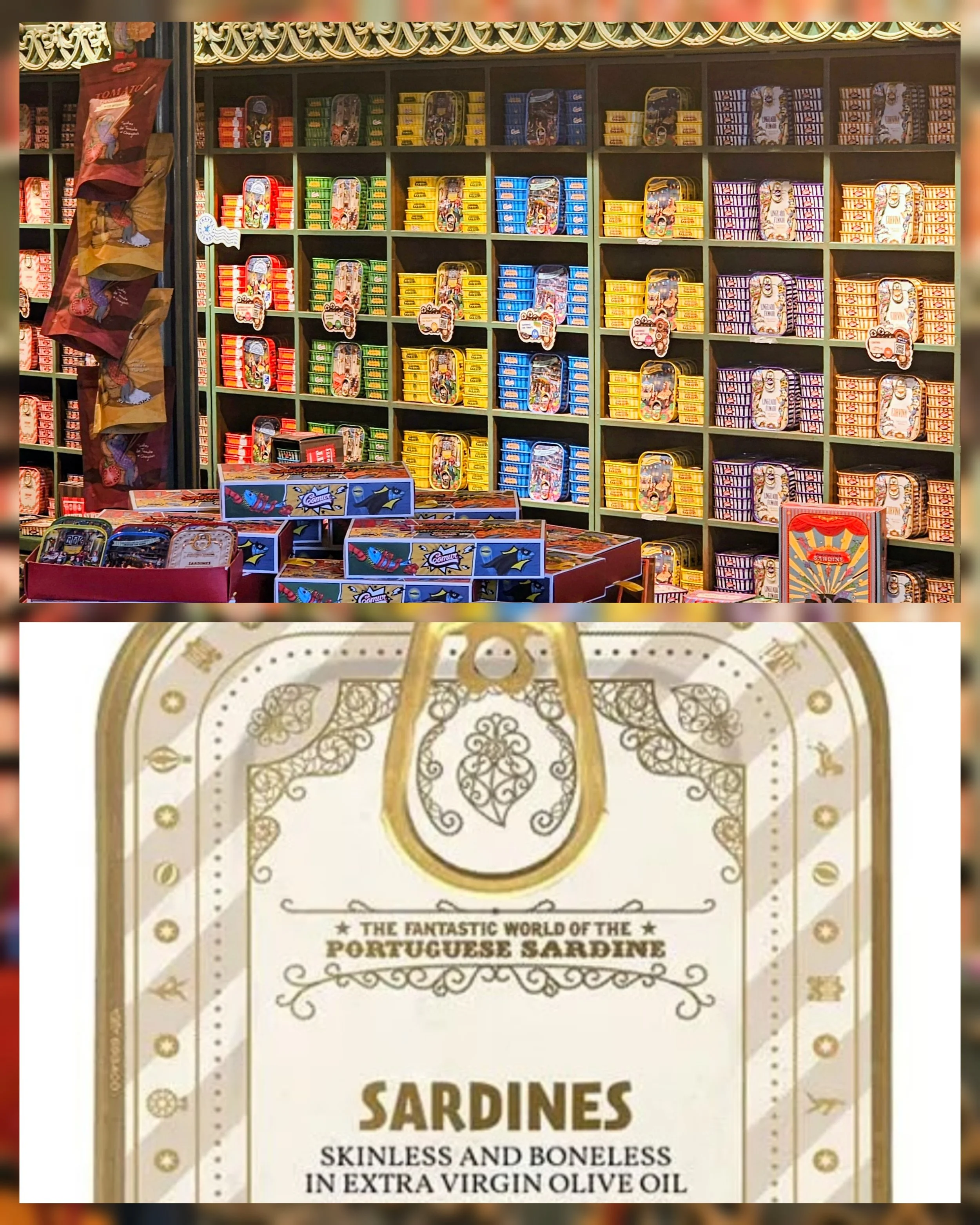
I discovered The Fantastic World of Portuguese Sardines while travelling through Portugal with two dear friends and, frankly, couldn't leave the country without bringing a few tins home.
Despite the name, this is not just a world of sardines. There's mackerel, cod, tuna, octopus, shrimp and even lobster, prepared simply in olive oil or dressed up with herbs, spices and sauces.
And then there are the tins themselves.
Bright, colourful and beautifully designed, they turn humble canned fish into something approaching a luxury object. Some are even marked with individual years, making them wonderfully quirky gifts, although I confess mine were bought with every intention of eating them.
I'm not alone in being seduced. Reviewers describe the shops as part gourmet emporium, part spectacle, praising the huge selection, striking packaging and quality of the fish. One visitor admitted wishing she'd bought more after opening her tins at home.
Now, a warning: they are not cheap, and some reviewers think the whole thing is a beautifully packaged tourist trap. They may have a point. But we're talking about the end of civilisation here. Standards must be maintained.
So alongside the bottled water, batteries and baked beans, I'm making room for a few tins of Portuguese lobster and smoked cod.
After all, who says the apocalypse can't have a little luxury?

A Marriage, a Swimming Pool and One Very Long Sunday
Sometimes I want a book that will keep me company for three weeks.
And sometimes I want one I can devour in an afternoon and then think about for the next three days.
Jessica Anthony's The Most is definitely the latter.
It's November 1957 and Kathleen Beckett, former college tennis champion, now wife, mother and homemaker, decides she isn't going to church with her husband and two sons. Instead, she puts on an old red bathing suit, gets into the swimming pool of their Delaware apartment complex...
...and refuses to come out.
That's essentially the premise. But beneath that deceptively simple set-up is a wonderfully sharp examination of marriage, ambition, disappointment, infidelity and the compromises women of that generation made when they exchanged the lives they might have had for the lives they were expected to want.
At just 144 pages, there isn't an ounce of fat on it. The story unfolds over a single day, moving between Kathleen and her husband Virgil as the cracks in their respectable 1950s marriage slowly show.
The critics loved it. NPR declared that this "superb short novel" deserves to become a classic, while The Washington Post called it darkly funny and a meditation on mid-century middle-class disappointment. Readers have been a little more divided, which, frankly, makes for a much better book-club conversation.
I loved its restraint. Nobody throws crockery or delivers grand speeches. Kathleen simply gets into a swimming pool and decides she isn't coming out. And somehow that tiny act of rebellion says almost everything. It's clever, slightly wicked, beautifully economical and short enough to read in one delicious sitting.
Put the kettle on, cancel your afternoon and dive in.